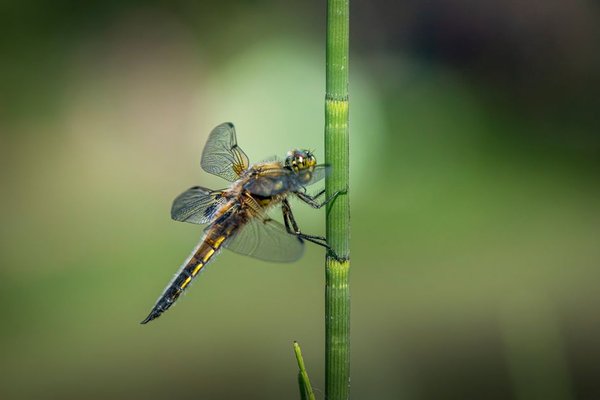
A dragonfly skimming over a pond looks perfectly at home in the air. Yet most of its life may have unfolded underwater, where it crawled through plants or sediment and hunted small animals with a remarkable hinged jaw. The dragonfly life cycle connects two different habitats: an aquatic childhood and a brief, winged adulthood. Understanding that change explains why healthy ponds matter just as much as the insects we see flying above them.
What Are the Stages of the Dragonfly Life Cycle?
Dragonflies develop through three main stages: egg, nymph and adult. The dramatic event called emergence marks the final change from nymph to adult, rather than a separate developmental stage. Scientists describe dragonfly metamorphosis as incomplete metamorphosis because there is no pupal or chrysalis stage, unlike the development of butterflies.
The familiar flying dragonfly is not born with wings. It must grow underwater, moult repeatedly and eventually climb out of the water to make its final transformation.
Stage One: Eggs Laid in or Near Fresh Water
The cycle begins when a female deposits eggs in freshwater habitat. Depending on the species, she may dip her abdomen into a pond or stream and release eggs into the water. Others insert eggs into aquatic plants, soft material or damp vegetation near the water’s edge.
Eggs do not all hatch on the same timetable. Some develop within weeks, while others remain dormant through colder conditions and hatch in a later season. Temperature, species and local conditions influence the timing.
A tiny form called a prolarva emerges first. It quickly moults into the recognisable aquatic nymph, beginning the longer feeding and growing portion of the insect’s life.
Stage Two: The Underwater Dragonfly Nymph
A Predator Hidden in Plain Sight
A dragonfly nymph, sometimes called a naiad, hardly resembles the colourful adult. It has six legs, a sturdy body and no functional wings. Brown and green colouring helps many species disappear against pond mud or submerged vegetation.
Despite its quiet appearance, the nymph is an accomplished hunter. Its lower lip, or labium, forms an extendable catching apparatus that shoots forward to seize prey. Smaller nymphs feed on animals such as mosquito larvae, worms and other aquatic insects. Larger individuals may also take tadpoles or very small fish.
Dragonfly nymphs are predators, but they are also prey for fish, birds and larger aquatic animals. They occupy a working part of the pond food web rather than simply waiting to become adults.
How Can It Breathe Underwater?
True dragonfly nymphs take up oxygen using specialised surfaces inside the rear abdomen, in a chamber often described as containing rectal gills. They draw water into this chamber and expel it again. A forceful expulsion can also propel the nymph through water.
Damselfly nymphs look different: most have three leaf-like gills projecting from the end of the abdomen. This is one useful clue when comparing dragonflies and damselflies.
Growth Happens Through Repeated Moults
An insect’s outer skeleton cannot stretch indefinitely. As a nymph grows, it sheds that covering and forms a larger one. This is called moulting, and it happens many times before adulthood. The exact number depends on the species.
The underwater stage can last only a few months in some dragonflies, but one or two years is common for many species. Others spend several years as nymphs. Cooler water, limited food and species-specific life histories can slow the process.
During later growth, developing wing pads become visible on the nymph’s back. They preview the flying adult, but are not working wings.
Stage Three Begins With Dragonfly Emergence
When development is complete and conditions are suitable, the mature nymph leaves the water. It may climb a reed, rush, rock or another firm support. This is a vulnerable moment: the insect has left its underwater shelter but cannot yet fly.
The skin splits along the back of the thorax. The adult gradually pulls its head, legs and body free, pausing while its new legs gain strength. Its wings are initially soft and crumpled. Fluid moves into their veins, expanding them while the abdomen lengthens and the new outer covering hardens.
The empty nymph skin remains attached to the support. Called an exuvia, it shows that dragonfly emergence occurred there. The transformation often takes hours, and the newly emerged adult may need more time before its first flight.
Bad weather, disturbance and predators can make emergence dangerous. Touching or moving a soft-bodied dragonfly can damage its developing wings, so watching from a distance is usually best.
The Adult: Hunting, Mating and Returning to Water
Freshly emerged adults, known as tenerals, are often paler and weaker in flight than mature dragonflies. Over the following days their bodies harden, colours develop and they become agile aerial hunters. They catch flying insects using sharp vision and manoeuvrable wings.
After reaching maturity, adults seek mates. Some males defend stretches of water while others patrol or compete in less territorial ways. Following mating, females lay eggs in suitable habitats, connecting the aerial adult stage to the underwater beginning.
Adults often live for weeks rather than years, although longevity varies by species and circumstances. Their flying stage may be only a small fraction of the animal’s total lifespan.
How to Spot the Life Cycle at a Pond
At a garden pond or quiet wetland, look for cast nymph skins on upright stems just above the waterline during the local emergence season. Their split backs and hollow bodies distinguish them from living insects. Examine them without pulling plants apart or disturbing emerging adults.
Another clue is a dragonfly repeatedly touching water with the tip of its abdomen. Depending on the species, this may be a female depositing eggs. Both signs connect the two habitats that the same species needs. A wildlife pond with shallow edges, native aquatic plants and undisturbed emergent stems can provide places for egg-laying, hunting and emergence.
Frequently Asked Questions
Does a dragonfly have four life cycle stages?
No. Dragonflies have three main stages: egg, nymph and adult. Emergence is the final moult, not a separate pupa stage.
How long does a dragonfly stay underwater?
It depends on the species and conditions. Many spend one or two years as aquatic nymphs; some develop in months and others require several years.
Do dragonfly nymphs turn into pupae?
No. Dragonfly nymphs undergo incomplete metamorphosis. Their final moult directly produces the winged adult without a cocoon or chrysalis.
What is the empty shell on a reed?
It may be an exuvia, the abandoned outer skeleton of a nymph. A split along its upper body suggests that an adult emerged from it.
From Pond Bottom to Open Air
The most surprising part of the dragonfly life cycle is not simply the appearance of wings. It is the change in how the insect breathes, hunts and moves. An underwater predator becomes an aerial one, leaving a delicate cast skin as evidence. Protecting the wetland where that change begins helps ensure there will be dragonflies hunting above it later.