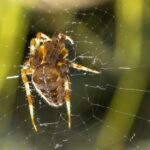
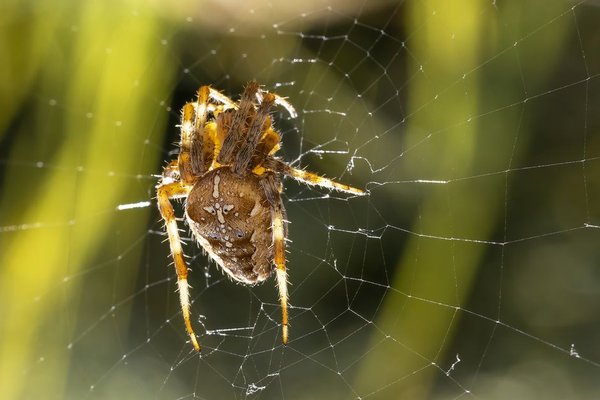
A cluster of tiny yellow spiders on a garden web and a large brown spider crossing the hallway may look unrelated. Both are snapshots of the same process: the spider life cycle. Spiders begin inside silk-wrapped egg sacs, emerge as spiderlings, grow through repeated moults and become adults capable of breeding. The timing varies between species, particularly across the UK’s changing seasons.
The Main Stages of Spider Development
Most spiders follow a sequence of egg, spiderling, growing juvenile and reproductive adult. Unlike butterflies, spiders do not pass through a caterpillar-like larval stage or pupa. Young spiders generally resemble smaller adults, although their reproductive organs are immature. Some even undergo an early moult inside the egg sac.
Adult Spiders Mate
The cycle begins again when mature males and females find one another. A male transfers sperm using specialised structures at the tips of his pedipalps, the small appendages near his mouth. Courtship matters because a female may mistake an approaching male for prey. Different species signal through web vibrations or movement.
After mating, a female may lay eggs quickly or produce them much later. Nor does every female eat her mate: cannibalism occurs in some spiders, but it is far from universal.
Eggs Are Protected in a Silk Sac
Female spiders surround their eggs with silk instead of leaving them exposed. Spider egg sacs can resemble cottony balls, flattened patches or textured bundles tucked among leaves. Their appearance and location vary by species. A female may make one sac or several.
The silk provides protection, although predators and parasites can still find the eggs. Parental care varies too. Some females guard a fixed sac; wolf spiders carry theirs attached to their spinnerets, while nursery web spiders carry a sac in their jaws before building a nursery for their young.
Spiderlings Hatch and Emerge
Hatching from the egg and leaving the sac do not always happen together. In certain UK species, young spiders hatch, moult and remain sheltered inside until conditions favour emergence. An autumn egg sac may therefore appear inactive through winter before releasing spiderlings in spring.
Newly emerged spiderlings are small and vulnerable. They sometimes gather briefly before dispersing. Although they already resemble tiny adults, their bodies and hunting abilities develop through subsequent moults.
How Spiderlings Grow into Adults
Moulting Makes Growth Possible
A spider’s outer skeleton cannot expand indefinitely. To grow, it must shed this covering in a process called moulting. Before a moult, a juvenile may stop feeding and retreat somewhere sheltered. The old exoskeleton splits, the spider emerges and its new covering gradually hardens. During this time it is especially vulnerable.
Spider moulting occurs repeatedly during juvenile development, but there is no universal number of moults. Species, sex, food and temperature all matter. In most familiar UK species, the final moult produces an adult. A papery, empty spider-shaped skin caught in a web is often evidence of growth, not a dead spider.
Hunting and Dispersal
Independent spiderlings must catch suitably small prey. Young orb-weavers build little webs, whereas hunting spiders locate insects through movement and their senses. A poor food supply can slow development.
Some young spiders disperse by releasing silk strands that catch moving air, a behaviour known as ballooning. Others walk to nearby shelter. Spreading out reduces competition among siblings, although it introduces new dangers.
When Does the Spider Life Cycle Happen in the UK?
There is no single British spider calendar. Species have different breeding periods, and weather shifts the dates. Two common examples explain why an autumn egg sac and an autumn adult spider represent different points in development.
Garden Spiders: Autumn Eggs, Spring Young
The common garden spider, an orb-weaver found on large circular webs, typically mates in late summer or autumn. Females wrap hundreds of eggs in dense silk. The next generation becomes conspicuous in spring, when clusters of yellow-and-black spiderlings gather on threads. The youngsters gradually separate and grow through the warmer months.
Should you spot such a cluster on a hedge, leave it undisturbed. The spiderlings may scatter when startled and later regroup. Watching from a short distance reveals this behaviour without interfering with it.
House Spiders: Autumn Adults on the Move
Large house spiders in the Tegenaria and Eratigena groups often appear from August to October because adult males leave their retreats to seek females. They have not suddenly hatched indoors. The Natural History Museum explains that young house spiders can reach maturity within about a year. Males often die after mating; females may survive into another breeding season.
Enlarged pedipalps resembling tiny boxing gloves are a clue that a wandering male is mature. An identification guide to common UK house spiders can help distinguish likely species.
Watching Spider Development in Your Garden
Imagine finding a pale egg sac beneath a shed window in March. Rather than opening it, photograph it from the same position each week. Record the date, weather and nearby spider activity. Look for signs of emergence without touching the silk; the exact timetable may differ from your expectations.
Do not move, cut open or spray the sac. Let emerging young disperse naturally. You can also look for discarded moults near webs and compare web shapes. Guides to spider egg sacs and different spider webs provide useful clues, although neither feature always proves a species’ identity.
How Long Does the Full Cycle Take?
There is no fixed duration. Some species mature rapidly in favourable conditions, while others need a year or longer. Temperature, food and seasonal patterns influence their pace. Many adults live only part of a season, although some females, including large house spiders, can live much longer.
Not every egg survives to adulthood. Spiderlings face predators, parasites, starvation and unsuitable weather. Producing many young helps populations persist even when only a small proportion survive to breed.
Frequently Asked Questions
Do baby spiders look like adult spiders?
Generally, yes. Spiderlings have the same basic eight-legged body plan but are much smaller and not sexually mature. Colours and proportions may change as they grow.
How many times does a spider moult?
The number varies by species. Juveniles moult several times before reaching adulthood; there is no standard count for every spider.
Do spider eggs hatch in winter?
In some species, eggs or newly hatched young remain protected inside sacs over winter, emerging when conditions improve. Other spiders follow different schedules.
Does every spider mother protect her babies?
No. Some leave their egg sacs, while others guard or carry them, and a few protect the spiderlings after emergence.
From One Generation to the Next
The remarkable feature of the spider life cycle is gradual development rather than dramatic transformation. Silk-wrapped eggs, clustered spiderlings, discarded skins and wandering mature males reveal different chapters. Knowing what to look for makes ordinary UK gardens, sheds and homes rewarding places to observe spiders.