
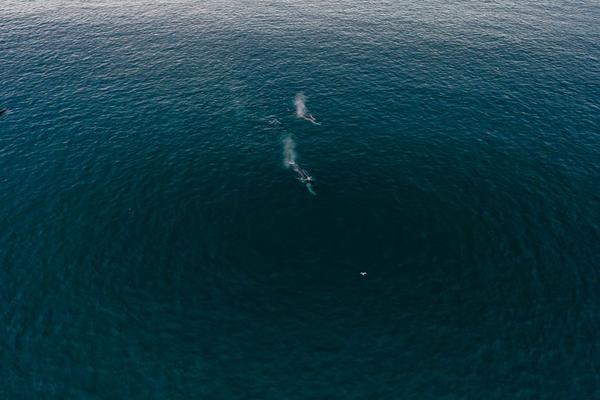
A minke whale can surface unexpectedly near a British coastline, show a curved dark back and small dorsal fin, then vanish before anyone raises a camera. These fleeting encounters help explain the fascination with minke whales in UK waters. They are Britain’s most regularly sighted baleen whales, particularly in summer, but finding one still takes patience.
The common minke whale, Balaenoptera acutorostrata, uses productive feeding areas around Scotland and elsewhere in Britain. Knowing its appearance, habitat and behaviour makes a brief sighting easier to recognise and appreciate.
How to recognise a minke whale
Minke whales are small compared with other baleen whales, yet adults commonly reach around 7–9 metres, and some females exceed 10 metres. Their bodies are streamlined and dark grey to almost black, with a paler underside, a narrow pointed head and a curved dorsal fin positioned well back along the body.
A distinctive white band crosses each pectoral flipper, although it is often hidden underwater. From shore or a boat, the most useful clues are the smooth, rolling back and relatively small dorsal fin. The blow can be difficult to spot, unlike the tall spouts produced by some larger whales.
Minkes do not usually raise their tail flukes above the surface before a dive. If identification remains uncertain, compare the sighting with a UK whale species identification guide rather than relying on size alone.
Minke whale habitat around Britain
Minke whale habitat ranges from coastal waters to offshore seas. What matters most is access to prey. Currents, seabed features and seasonal concentrations of fish can make one area productive, while a nearby stretch of water seems almost empty.
Western Scotland and the Hebrides
The Inner Hebrides, including waters around Mull, Coll and the Small Isles, are closely associated with summer sightings. Minke whales also appear around other sections of western and northern Scotland. Records change from year to year because feeding conditions and fish distribution change.
The North Sea and elsewhere
The North Sea supports minke whales too, including waters off eastern Scotland and northeastern England. Animals are recorded in other parts of UK waters, but sightings are less predictable around many southern coasts. A map showing where whales have appeared does not necessarily identify reliable viewing locations.
Before arranging a trip, consult recent reports from local wildlife groups and operators rather than assuming a historically productive site will always deliver an encounter.
When can you see minke whales in the UK?
Late spring to early autumn provides many of the best opportunities. Sightings often increase from May and continue into October, with summer particularly productive around western Scotland. Calm conditions improve the chance of noticing a brief surfacing, although good weather cannot guarantee whales.
Migration is not fully understood. Some minke whales appear to move towards different latitudes or offshore waters as seasons change; others may remain closer to Britain. There is no single confirmed winter route followed by every whale seen here.
For anyone tracking whale sightings UK records, the practical combination is recent local reports, suitable sea conditions and enough time to scan patiently.
What do minke whales eat?
The minke whale diet in British waters commonly includes sandeels, herring and sprat. These fish can gather in schools, allowing a whale to capture substantial amounts of food in a single feeding movement. Other fish and small marine animals may also be eaten depending on availability.
Minkes are baleen whales, not toothed predators. They accelerate towards prey, open their mouths and take in fish with large volumes of seawater. Expandable throat grooves accommodate the mouthful; baleen plates then filter out the water while retaining food.
Feeding whales sometimes roll or lunge near the surface. Diving seabirds and patches of disturbed water may signal schooling fish below. Minke whales have been observed feeding on sandeels around the Small Isles, a vivid example of how local prey concentrations shape their distribution.
How do minke whales behave?
Minkes are often solitary, although several may use the same feeding ground when food is plentiful. They are efficient, relatively fast swimmers and generally less showy than humpback whales. A typical encounter involves a few surfacings, breaths and a quiet disappearance beneath the water.
One whale may reappear repeatedly within a small area while feeding; another may surface briefly and continue travelling. Researchers can sometimes recognise individuals through photographs of dorsal-fin shapes, scars and pigmentation, helping reveal which whales return to particular areas.
For a closer look at the feeding strategy, a guide to how baleen whales feed provides helpful context.
Watching minke whales responsibly
On a calm day near Mull, start by scanning the horizon slowly and watching for a dark back rolling through the surface. Once you spot something, look in its direction of travel instead of following every wave. Binoculars help with distant details, but regular wide scans prevent missed sightings.
Boat operators should never chase a whale, cut across its path or try to force a close encounter. Allow it space to swim and feed. NatureScot’s Scottish Marine Wildlife Watching Code sets out guidance to reduce disturbance; shore-based observation is an especially low-impact option.
Record the date, approximate location, number of animals and behaviour if you can do so safely. Clear photographs may assist identification, and submitting observations to a recognised local sightings scheme can support monitoring.
Protection and conservation
Minke whales are protected in UK waters, but they still face pressures. Fishing-gear entanglement, vessel collisions, underwater noise and changes in prey availability can affect individuals or their habitat. A rise or fall in reports from one coastline does not, by itself, establish a population-wide trend.
Research surveys, responsible wildlife tourism and habitat conservation all contribute to better protection. Learning about UK marine protected areas can help explain why safeguarding feeding grounds matters alongside protecting the whales themselves.
Frequently asked questions
Are minke whales common in the UK?
They are the most frequently encountered baleen whales around Britain, especially in summer. Nevertheless, their distribution varies and sightings cannot be guaranteed.
Where is the best place to see minke whales?
Western Scotland, especially around Mull and the Inner Hebrides, is well known for encounters. The North Sea is another important area. Recent local sightings are the best guide for a specific visit.
Do minke whales leave Britain in winter?
Some move seasonally, but their exact movements are not completely understood. Winter reports are fewer, and not every individual is known to follow the same migration route.
Are minke whales dangerous to humans?
They are powerful wild animals but are not known for deliberately targeting people. Watch from a respectful distance rather than attempting to approach or swim alongside them.
A quieter highlight of Britain’s seas
Seeing a minke whale may mean only a few seconds of dark back against grey water. That is part of its charm. Recognising its shape, understanding why it follows fish and keeping a respectful distance turn a fleeting encounter into a deeper appreciation of Britain’s marine life.