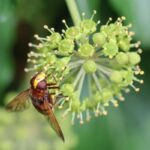
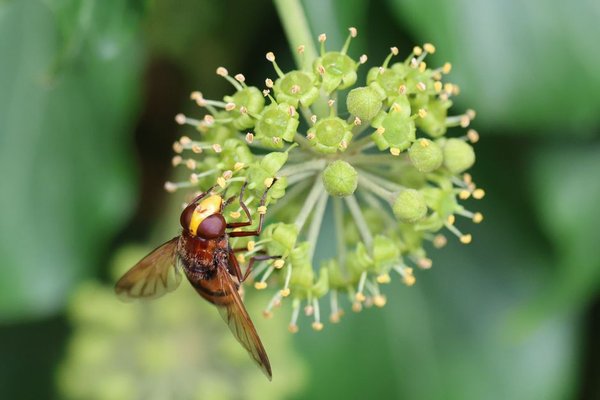
A yellow-and-black insect pauses beside a flower, hangs almost motionless in the air, then darts sideways. At first glance it looks like a wasp. Watch a little longer, though, and you may be looking at one of Britain’s most useful and frequently misunderstood insects: a hoverfly.
Hoverflies in the UK come in an impressive variety of shapes, from slim, striped visitors to furry bee lookalikes. Their resemblance to stinging insects is deliberate evolutionary disguise, but their real lives are much more interesting than the costume suggests. They pollinate flowers, and the young of some species tackle aphids that damage garden plants.
How to identify a hoverfly in the UK
Hoverflies belong to the fly family Syrphidae. Britain has more than 280 recorded species, so no single colour pattern identifies them all. Many carry yellow bands or spots; others are dark, metallic or covered in dense hair. For reliable UK hoverfly identification, look at several features together rather than trusting the stripes.
Wings, eyes and body shape
Like other true flies, hoverflies have one functional pair of wings. Bees and wasps have two pairs, although those wings can overlap and be difficult to count on a moving insect. Hoverflies also tend to have large eyes and relatively short antennae. Most lack the sharply pinched waist typical of many wasps.
In a sharp close-up photograph, the pattern of wing veins offers stronger evidence. Hoverflies have a distinctive false vein, called the spurious vein, but spotting it often requires magnification. Some very similar species cannot be separated confidently from an ordinary garden photograph, and that is perfectly normal.
Flight gives away the disguise
The classic hoverfly behaviour is to hold position in mid-air, then accelerate or change direction with surprising precision. A wasp may also hover briefly, so flight alone is not proof. Combined with large eyes, a broad join between thorax and abdomen, and one pair of wings, however, it is an excellent clue.
Why hoverflies mimic bees and wasps
Hoverfly mimicry is a form of protection. Many predators recognise the warning colours of insects that can defend themselves with a sting. By resembling those insects, a harmless hoverfly may persuade a bird or other hunter to leave it alone. This is known as Batesian mimicry: an undefended species gains some protection by looking like a defended one.
The imitation can be remarkably specific. Some hoverflies resemble yellow-and-black social wasps; others resemble honeybees or furry bumblebees. The resemblance is not always exact to human eyes, and different predators may respond differently. A striped body is therefore neither a sign of aggression nor enough to determine the species.
Unlike the insects they imitate, hoverflies have no sting and do not bite people. If a striped visitor settles briefly on your hand, it is not preparing to attack. Let it leave in its own time rather than swatting it. For genuinely stinging lookalikes, a separate UK wasp identification guide can help explain the differences.
Three hoverflies you may recognise
Marmalade hoverfly
The marmalade hoverfly, Episyrphus balteatus, is a familiar sight on summer flowers. Its orange abdomen carries narrow black markings that give it a distinctive banded appearance. This species breeds in Britain, and migrants arriving from continental Europe can add considerably to local numbers. Its larvae eat aphids.
Drone fly
The common drone fly, Eristalis tenax, resembles a honeybee more than a wasp. Look for its stout brownish body and broad, fly-like eyes. Its larvae develop in water rich in decaying organic material and breathe through a long tube, which explains the nickname ‘rat-tailed maggots’. Adults visit flowers for nectar and pollen.
Hornet mimic hoverfly
Volucella zonaria is a particularly striking example of mimicry. Roughly 2 cm long, it can look alarmingly like a hornet, but its single pair of wings and unpinched waist reveal a fly. It has become more widespread in Britain, especially in southern areas. Its larvae develop in social wasp nests, feeding on waste and other material there.
Why these pollinating flies matter
Adult hoverflies visit flowers to feed on nectar and pollen, transferring some pollen as they travel. They complement bees rather than simply replacing them. Different body sizes, seasonal activity and flower preferences mean a mixture of pollinators helps plants reproduce across gardens, farmland and wild habitats.
The larval stage is equally varied. In many species, soft-bodied larvae hunt aphids. A female may lay eggs near an aphid colony, giving newly hatched larvae a ready food supply. Other hoverfly larvae live in wet decaying matter, rotten wood or even social insect nests. Not every hoverfly is an aphid predator.
Where and when to look for hoverflies
Sunny, sheltered spots are ideal places to begin. Watch flowering borders, hedgerows, allotments, woodland edges and parks from spring into autumn. The exact season varies between species and with the weather. Some adults also appear on mild days outside the main summer period.
Try standing beside a patch of flowering ivy in early autumn. Rather than scanning the whole garden, watch one cluster for five minutes. You may see different hoverflies arriving to feed, then departing on rapid, direct flights. Take a photograph from above and from the side if possible; both angles help with later identification.
Helping hoverflies in a British garden
Offer flowers over a long season rather than relying on one spectacular summer display. Open, easily accessed blooms are especially valuable. Plants such as yarrow, fennel, marigolds and ivy can contribute at different times; choose varieties suited to your soil and space. A guide to flowers for garden pollinators can help plan the sequence.
Avoid routine insecticide use, particularly on flowering plants, and tolerate some aphids where damage is manageable. Those aphids may become food for beneficial larvae. Leave a few sheltered areas with leaf litter or natural materials, and avoid disturbing every damp corner, while keeping garden water features safe and maintained.
Frequently asked questions
Do UK hoverflies sting?
No. Hoverflies cannot sting, even when their markings closely resemble wasps, bees or hornets. They are harmless to people and are best left to continue feeding.
How can I tell a hoverfly from a wasp?
Look for a single pair of wings, large fly-like eyes and usually no narrow wasp waist. Hovering flight is another clue, but photographs of body shape and wings are more dependable than colour alone.
Are all hoverfly larvae good for aphid control?
No. Many familiar garden species have aphid-eating larvae, but others feed on decaying organic matter or use different habitats. The benefits of hoverflies extend beyond pest control to pollination and recycling nutrients.
What flowers attract hoverflies in the UK?
Accessible, pollen-rich flowers such as yarrow and fennel can be attractive, while ivy provides valuable late-season nectar. Planting a varied succession of blooms is better than depending on a single species.
A closer look changes the picture
The next time a wasp-shaped insect hovers over a flower, give it a second look. Its wings, eyes and way of flying might reveal a hoverfly: a harmless master of disguise with an important place in British wildlife. Learning to recognise these pollinating flies turns an ordinary few minutes outdoors into a much more revealing wildlife encounter.