
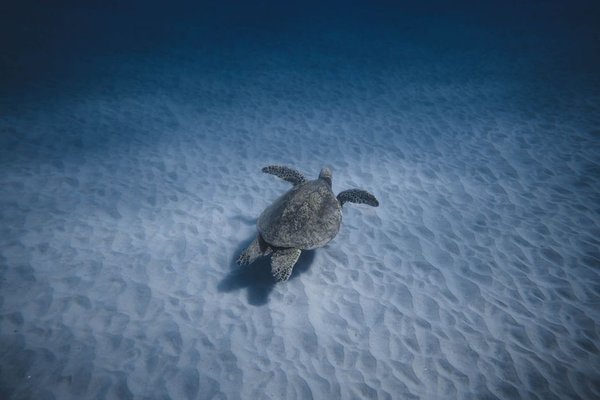
A sea turtle may spend years feeding along one coast, then cross open water toward a distant nesting beach. No landmarks are visible for much of the trip. Yet these reptiles travel enormous distances and often return to familiar places with remarkable consistency. Sea turtle migration connects feeding grounds, breeding areas and nesting beaches across entire ocean basins. That journey explains why protecting a beach alone is rarely enough to protect the turtles that use it.
Migration Is More Than One Long Swim
Marine turtles do not all follow the same schedule or route. Their movements depend on species, age, food availability and reproductive stage. Some adults travel between coastal feeding areas and nesting beaches. Others spend substantial time in the open ocean, where currents and prey shape their journeys.
Females leave the sea to lay eggs, often returning to the broader region where they hatched. They may nest several times during a breeding season, then return to feeding grounds. Many do not breed every year. Males also make reproductive migrations, but ordinarily remain at sea. These journeys are part of a longer sea turtle life cycle, beginning with a hatchling’s first swim offshore.
How Do Sea Turtles Navigate Across Oceans?
The mystery of turtle navigation is not simply how an animal maintains direction. It is how a turtle finds a destination after travelling through moving water, sometimes for thousands of kilometres. Researchers have identified several useful cues, although the combination used likely changes with age and circumstances.
Earth’s Magnetic Field Provides a Compass and Map
Earth’s magnetic field differs subtly from place to place. Changes in field strength and the angle at which magnetic lines meet the planet’s surface can provide information about direction and location. Experiments with young turtles show they respond to magnetic signatures associated with different ocean regions.
Research published in 2025 found that juvenile loggerheads can learn to associate particular magnetic fields with food. That strengthens evidence that turtles learn magnetic information about useful places, rather than relying on a fixed compass heading. Scientists have also found evidence that the magnetic map and compass involve distinct sensory mechanisms. Exactly how turtles detect magnetic fields remains an active research question.
Waves, Light, Currents and Experience Matter Too
Hatchlings use visual cues to move toward the sea, and wave direction helps them orient offshore. Ocean currents can carry young turtles along broad routes, but swimming behaviour also influences where they end up. Older turtles may draw on experience and other environmental signals. Evidence is strongest for magnetic navigation; claims that every turtle follows a precise scent trail or memorises one unchanging path go beyond established findings.
From Hatchling Drift to Adult Return
For many turtles, migration begins before they can actively cross an ocean. Hatchlings enter nearshore waters and move offshore, where currents shape years of development. Juvenile loggerheads in the North Atlantic, for example, are associated with the broad circulation of the Atlantic gyre.
As they grow, many turtles shift toward productive coastal feeding areas. Later, mature individuals travel between those grounds and breeding regions. This explains why a nesting female can appear at a familiar beach after years elsewhere. It also explains why protecting hatchlings at the shoreline is only the beginning of conservation.
Sea Turtle Routes Differ by Species
Leatherbacks Cross Vast Ocean Basins
Leatherback turtles are exceptional travellers that seek jellyfish and other soft-bodied prey. NOAA tracking research has documented western Pacific leatherbacks moving from nesting regions around Indonesia, Papua New Guinea and the Solomon Islands toward feeding waters off North America. Some cross more than 10,000 kilometres. A turtle’s route may pass through several national waters and extensive stretches of international ocean.
Green Turtles and Loggerheads Link Distinct Habitats
Green turtles often use coastal seagrass or algae feeding grounds and migrate to sandy nesting beaches. Loggerheads may occupy oceanic habitats when young and coastal feeding areas later in life. Even turtles nesting on the same beach can use different feeding destinations. Sea turtle routes are therefore better understood as networks of habitats and corridors than as one universal line on a map.
Why Nesting Beaches Matter So Much
Turtle nesting migration involves more than reaching any convenient shore. Female turtles commonly show natal homing: a tendency to return to their birth region to reproduce. They do not necessarily land on the exact spot where they hatched. Magnetic information may help identify the region, while local conditions influence the final approach.
A suitable beach provides accessible sand above the regular reach of waves, where eggs develop. Artificial lighting, construction, disturbance and erosion can make nesting or hatchling emergence difficult. When watching turtles on a nesting beach, follow local wildlife guidance, keep lights off or shielded, maintain distance and never block an adult’s path between water and sand.
How Scientists Trace the Journeys
Satellite transmitters attached by trained researchers reveal where tagged turtles travel, including long crossings and feeding zones. Flipper tags identify individuals on later encounters, while genetics helps connect turtles at sea with nesting populations. Each method answers a different question. A satellite track shows one animal’s movement, not necessarily the route followed by every member of its species.
Consider a leatherback feeding off California. Its presence there tells only part of the story; tracking has linked such turtles to nesting populations across the Pacific. That connection gives fisheries managers a reason to coordinate across borders and seasons, rather than treating each coastline as an isolated habitat.
Threats Along the Migration Corridor
Long-distance movement exposes turtles to hazards far from their nesting beaches. Accidental capture in fishing gear, vessel strikes, marine debris and damaged feeding habitats can interrupt journeys. Climate change can affect marine food webs and nesting conditions. Protection therefore needs to cover feeding sites, migration routes and nesting areas, with cooperation between regions sharing the same populations.
Frequently Asked Questions
How far do sea turtles migrate?
Distances vary widely. Some move between nearby coastal habitats, while leatherbacks can cross ocean basins and travel more than 10,000 kilometres between major habitats.
How do sea turtles find their way back to nesting beaches?
Evidence suggests they use Earth’s magnetic field for orientation and geographical information. Other cues may help, especially near shore. Females generally return to a natal region, not necessarily one exact spot.
Do sea turtles migrate every year?
Not necessarily. Feeding movements can be seasonal, but breeding intervals differ among individuals and species. Many females skip one or more years between nesting seasons.
Do baby sea turtles follow the same routes as adults?
Usually not. Young turtles often spend years in oceanic habitats influenced by currents, whereas adults may travel between established feeding and breeding areas.
A Connected Ocean Journey
Sea turtle migration is a story of changing habitats and sophisticated navigation. Magnetic cues help turtles orient, ocean conditions influence their paths, and connections to nesting regions draw adults back across the water. To understand these travellers, look at the whole journey: from hatchling departure to feeding grounds, and eventually to the beach where the next generation begins.