Spotting ants in Britain is easy; naming the species can be harder. The dark ants crossing a patio, yellow ants beneath a grassy mound and larger red-and-black ants on woodland paths may belong to quite different groups. For identification, the best starting point is often not colour but the place where an ant lives.
This guide introduces common British ant species, their preferred habitats and the clues that make a field identification more reliable. It also explains when a photograph is enough for a reasonable guess and when specialist examination is needed.
What to look for when identifying British ants
Note the setting first: paving, short grass, damp soil, a tree trunk or woodland litter. Then observe worker size, body colour, nesting structures and whether ants travel singly or in busy trails. A photograph from above and another from the side can help with UK ant identification.
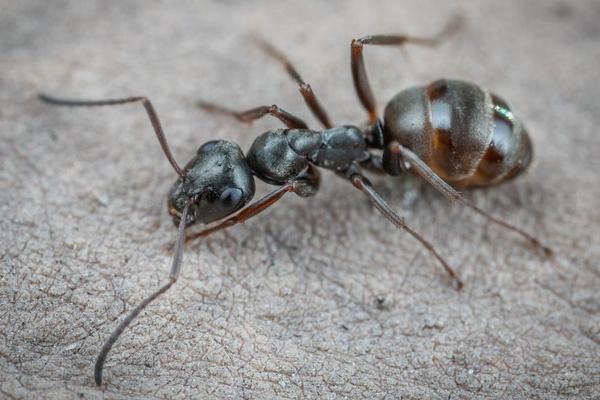
Colour is not conclusive. Some “black” ants are dark brown, and several reddish species look almost identical. Features such as the waist and antennae may need a hand lens or microscope to identify confidently.
Common British ant species and where they live
Black garden ant (Lasius niger)
This familiar dark brown-to-black species is abundant in many gardens, parks and built-up areas. Workers follow visible trails across patios, walls and paths, often searching for small insects or sugary honeydew produced by aphids.
Colonies favour warm, open ground and commonly nest beneath paving slabs, stones and other sun-warmed objects. Black garden ants sometimes enter kitchens looking for food. Large summer appearances of flying ants often involve this species, although related ants can look similar. Identifying every small dark garden ant as Lasius niger would be premature.
Yellow meadow ant (Lasius flavus)
Look for rounded earth mounds in old pastures, grassland, churchyards and undisturbed lawns. These structures are a strong clue to yellow meadow ants, whose small yellowish workers usually remain underground.
They feed partly on honeydew from aphids living among plant roots, so you may see the mounds long before you see an ant. Colonies can persist for years in places that escape frequent soil disturbance. A pale ant found under a stone, however, is not automatically Lasius flavus; other yellowish Lasius species exist.
Common red ant (Myrmica rubra)
Often found in damp gardens, parks, meadows and woodland edges, this reddish-brown ant nests in soil, grass tussocks, under stones and sometimes rotten wood. It takes small invertebrates, nectar and honeydew.
Unlike black garden ants, Myrmica workers possess a two-segmented waist and a functional sting. They may sting if handled or if their nest is disturbed. Several British red ants look similar, so a red worker in a flowerbed is a useful clue rather than a certain identification.
Common elbowed red ant (Myrmica scabrinodis)
This widespread species is associated especially with damp grassland, boggy ground and open vegetation. Nests occur in soil, beneath stones and among grass tussocks. It is less typical of very dry ground or houses.
Myrmica scabrinodis resembles other red ants, including Myrmica rubra. The shape of the antennae and other small features help specialists separate them. When those details are unavailable, recording “Myrmica species” is more accurate than guessing.
Red or southern wood ant (Formica rufa)
Large mounds of pine needles, twigs and plant fragments can reveal wood ant colonies in deciduous, mixed or coniferous woodland. Formica rufa occurs in England and Wales, particularly in suitable southern areas. Workers have reddish and darker body regions and may travel along conspicuous woodland routes.
Wood ants hunt invertebrates and collect aphid honeydew. Their mounds are valuable parts of woodland ecosystems, so observe without opening or damaging them. Several other wood ant species occur in Britain, especially farther north, and distinguishing them can require expert help.
Large black ant (Formica fusca)
Despite its name, Formica fusca is not simply a bigger garden ant. This dark species inhabits open woodland, woodland edges, heaths and some moorland sites, nesting under stones, in stumps, beneath bark or in grassy banks.
Workers commonly forage individually, hunting small insects or visiting aphids for honeydew. You might spot one crossing a woodland clearing rather than a crowded trail on a pavement. Similar Formica species mean habitat and size alone cannot confirm the identity.
Brown tree ant (Lasius brunneus)
Locally common in parts of England and Wales, this species favours mature trees, especially older oaks with damaged or deeply fissured bark. Workers often remain within bark crevices while tending aphids that provide honeydew.
Their brownish-red head and middle body contrast with a darker abdomen. They can also nest in decaying timber and occasionally buildings. Searching tree trunks rather than lawns is the practical trick for finding these relatively secretive British ants.
How ant habitats help narrow down the species
Even a small area can contain several ant habitats. A sunny patio may support black garden ants, while a damp border shelters Myrmica species. Long-established grass provides nesting space for yellow meadow ants; mature trees and woodland edges support other communities.
For a simple field exercise, compare three places during a warm summer walk: a paved edge, an undisturbed grassy patch and a tree-lined path. Photograph the setting and a worker, note any nest mound and avoid lifting stones or disturbing nests. Such context often proves more helpful than colour alone.
Related topics worth exploring are how ant colonies work, why flying ants appear in summer and the relationship between ants and aphids. Each helps explain behaviour that can support identification.
Frequently asked questions
What is the most common ant in British gardens?
The black garden ant, Lasius niger, is among the best-known and most frequently encountered. However, a single garden may support several species in different habitats.
Are all red ants in the UK the same species?
No. Myrmica rubra and Myrmica scabrinodis are two examples, and other Myrmica species can look very similar. Reliable species-level identification sometimes requires a microscope.
Do British ants usually nest inside houses?
Many familiar species nest outdoors in soil, beneath stones or within wood. Black garden ants can enter buildings to find food without necessarily establishing an indoor nest.
When do flying ants appear in Britain?
Mating flights often occur on warm summer days. For black garden ants they are especially familiar in July and August, although timing varies by species and weather. Flying ants are reproductive males and queens, not a separate species.
Conclusion
The most useful ant species guide starts with careful observation. Notice whether you are looking at a patio trail, meadow mound, damp tussock or woodland nest. Combine the habitat with body features and behaviour, and accept a broader identification when necessary. You can discover a surprising range of British ants without disturbing the places they call home.